
David Yambio addresses survivors in Brussels: “We are not forgetting what happened to us in Libya”


More than 2,000 survivors, victims and relatives of people currently trapped in Libya gathered in Brussels in front of the European Parliament, calling for an end to European support for detention, interception and abuse in Libya. The protest brought together people who had themselves passed through detention centres, trafficking networks, sea interceptions and other forms of violence, alongside families whose relatives remain imprisoned or missing.

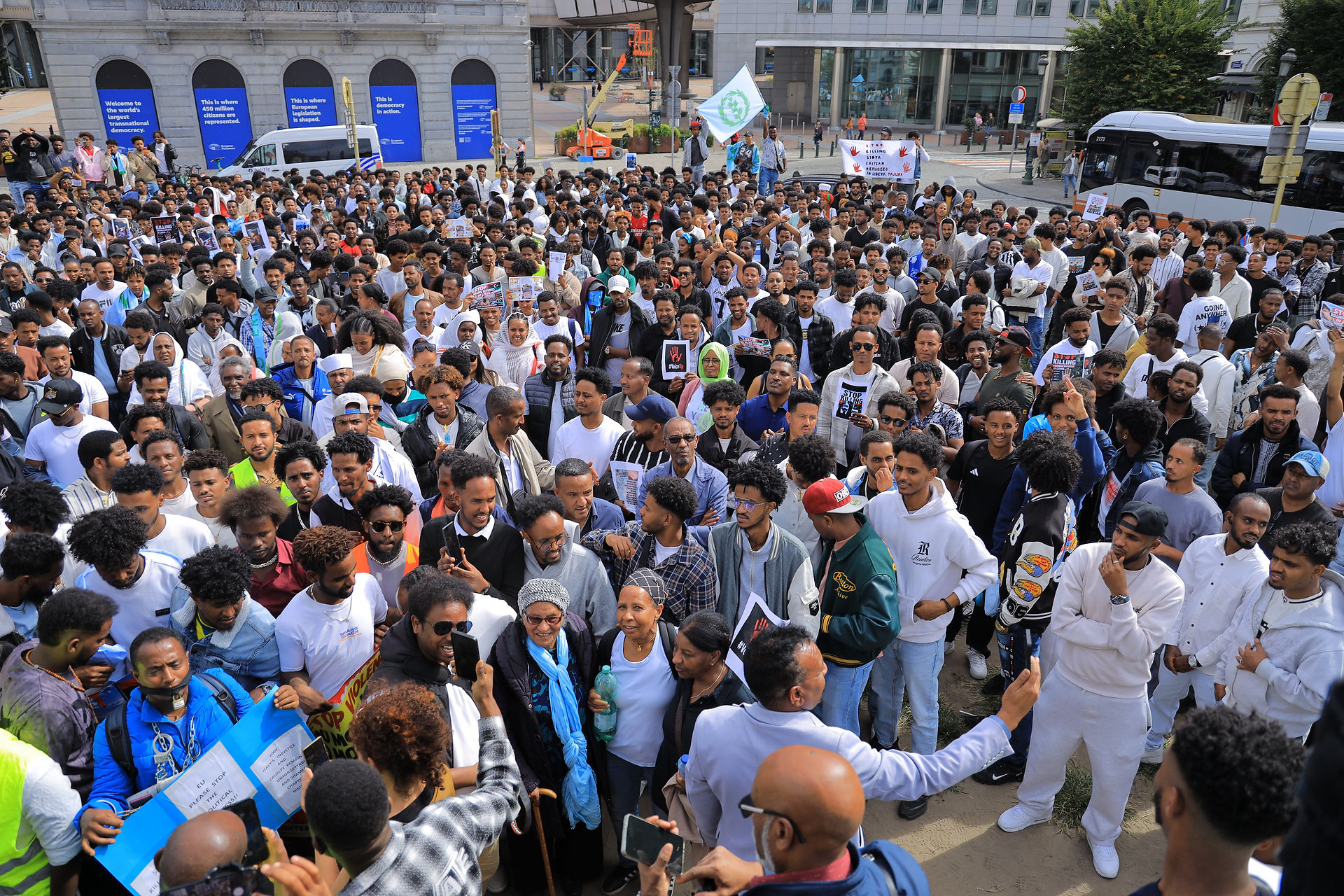

When David Yambio took the microphone, he did not begin by addressing European officials. He began by looking at the people standing in front of him.
“Seeing you today here, many colleagues, more than 1,000 of us here, we’ve lived and experienced all the horrors, the condemnation to death that Europe have put in place for so many years in Libya,” he said.
The opening was personal, but not individual. Yambio spoke as one survivor among many, repeatedly returning to the collective “we”. He referred to the scars carried by those present and to the people who had not been able to stand with them because they remained detained in Libya.
“We are not forgetting what happened to us in Libya, the scars that we have on our bodies. We are also not forgetting the brothers, the sisters, the friends and the comrades who are right now incarcerated and contained in the Libyan concentration camps. Many have died.”

His tone moved between testimony, anger and political accusation. Rather than presenting the protest as an appeal directed only at Europe, Yambio turned part of his condemnation towards African governments and the African Union.
“Our first anger and condemnation is being addressed to the African Union,” he told the crowd, arguing that the violence taking place in Libya was happening “within the African continent, within the African land, within the African territory” while African political leaders remained largely silent.
He questioned the flows of European money directed towards Libya under migration-control programmes and asked: “Who is receiving this money? Why are our leaders very silent? This is the question we’ve been posing for so many years.”

From there, Yambio placed the present migration regime within a longer political history. He spoke about colonialism, unequal mobility and what he described as the continued strangling of African aspirations.
“We know that the colonial legacy of Europe and the Western imperialism continue to strangle Africa. It continue to strangle our identity. It continue to strangle our dreams.”
For Yambio, the people standing before him were not simply victims of that system. Many had become organisers, documenters and investigators precisely because of what they had survived.
“What we have discovered all of these years, either from our experience, or from the work that we have been forced to do, as we have become investigators, we’ve become community builders, we see evidently that it is the state that is committing human trafficking.”
He then named routes between Tunisia and Libya, Egypt and Libya, Sudan and Libya, Chad and Libya, and Algeria and Tunisia, arguing that the movement and containment of people could no longer be understood only through the language of individual smugglers or trafficking networks. In his account, states themselves had become central actors in a system that moved, detained and returned people while describing the process as migration management.
One of the most striking parts of the speech was Yambio’s insistence that the idea that everyone in Libya was waiting to reach Europe was false. He reminded the crowd that Libya had historically also been a destination for African workers and could have been a place of refuge for people fleeing conflicts elsewhere on the continent.
“It is unfair to say, and to continue to build on the narrative, that everyone who is stuck now in Libya want to come to Europe,” he said. “Many of those who are in Libya have chosen, or would have chosen Libya to be a destination.”
As the speech developed, Yambio shifted from political denunciation to strategy. He told the crowd that street mobilisation was necessary but insufficient, and urged survivors to use courts and legal mechanisms alongside protests.
“There are legal avenues to fight beyond being in the streets. We need to fight more. We need to use the European institutional system, the judicial system across Europe to take them to court.”
He referred to legal proceedings in Europe, the role of Frontex and ongoing accountability efforts involving victims of crimes committed in Libya. He argued that survivors should not wait for institutions to decide when their rights mattered.
“We should not wait anymore to have our rights be given to us. Rights are not things that can be given. It’s something that we deserve, it’s something that needs to be protected and respected, and if necessary we have to fight for it.”
The distinction between speaker and crowd then began to disappear. Yambio moved into chants, and hundreds of voices answered him.
“Stop detention.”
“Stop killing our brothers in Libya.”
“Stop killing our sisters in Libya.”
“Stop raping our women in Libya.”
“Stop financing torture camps in Libya.”
Before the protest ended, Yambio returned once more to the question of what would happen after the crowd went home. He spoke about ongoing cases in the Netherlands and about the Libyan suspect currently in the custody of the International Criminal Court, where survivors of crimes committed in Libya are seeking recognition, participation and reparations.
He also announced that the mobilisation would not end with a single protest.
“Two hours is not enough to describe what our people are experiencing in Libya,” he said, telling those gathered that organisers intended to return for a longer sit-in when European officials were present.
The speech reflected the character of the demonstration itself. It was not organised simply around sympathy for people suffering elsewhere. Many of those standing before the European Parliament had themselves survived the system they were denouncing. Their presence turned the protest into something closer to a public assembly of witnesses: people carrying evidence in their memories and bodies, speaking about those still trapped, while demanding that political protest be followed by legal accountability.
Yambio’s role in that setting was therefore not merely that of a speaker addressing a crowd. He moved between survivor, organiser, witness and political advocate, speaking to people who shared much of the experience he was describing. His opening made that relationship clear before any demand was addressed to a government or institution: the first audience was the community itself, and the first act was remembrance.
Article by: Elsabet Tekleh


Comments